Blog

From Content Pipelines to OKR Alignment: Real AI Workflows Teams Run Inside Kollab

12 jun 2026enSency ShenProduct5 min read
image.png

How teams are replacing scattered AI tools with one workspace that actually remembers what you built.


Most teams don't have an AI problem — they have an AI fragmentation problem.

You use ChatGPT for writing, Midjourney for visuals, a browser extension for research, a spreadsheet for tracking, and Slack for everything in between. Every output gets copy-pasted somewhere else. Nothing connects. Nothing persists. And every time you start a new project, you start from scratch.

That's the problem Kollab was built to fix.

Kollab is an AI-native workspace where you and AI Agents get real work done together — writing, research, image generation, data analysis, web browsing, and more — all in one place. Outputs stay. Workflows are reusable. And your AI actually remembers what you built last week.

To make this concrete, here are eight real workflows teams are running inside Kollab right now.


1. Content Pipeline for Notion and Buildin

Who it's for: Content teams, editorial leads, SEO managers

From Content Pipelines to OKR Alignment: Real AI Workflows Teams Run Inside Kollab image

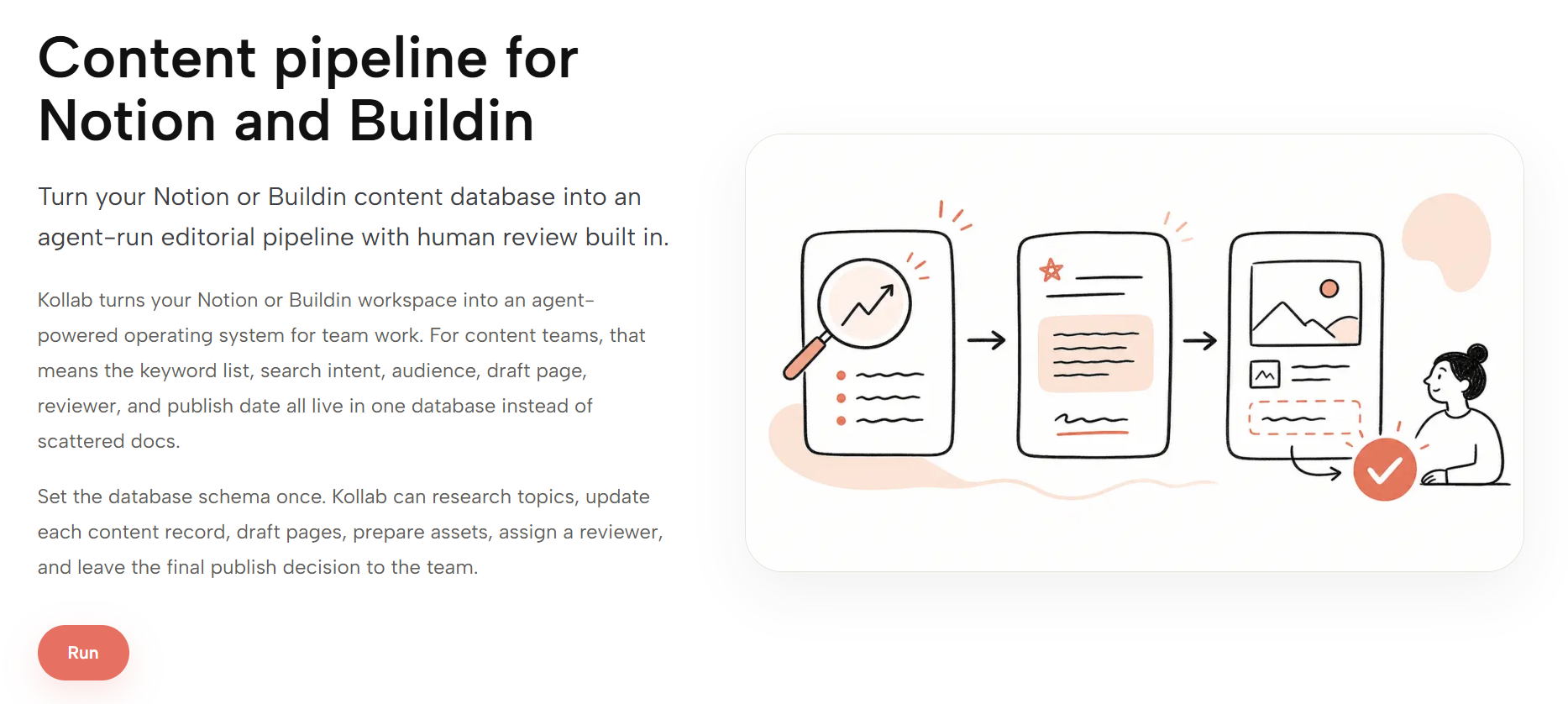
The problem: Keyword lists, search intent docs, draft pages, reviewer assignments, and publish dates live in five different places. Writers waste hours chasing status updates instead of writing.

How Kollab handles it: Connect your Notion or Buildin content database once. Every Monday, Kollab researches new content opportunities in your industry, creates structured records with keyword, search intent, audience, and publish date — then drafts the top three pages, attaches suggested visuals and internal links, assigns a reviewer, and moves each item to Ready for review.

"Set the database schema once. Kollab can research topics, update each content record, draft pages, prepare assets, assign a reviewer, and leave the final publish decision to the team."

Result: A fully-populated editorial database, three review-ready drafts, and a weekly summary — every week, automatically.

→ See the Content Pipeline use case


2. Weekly Business Review Automation

Who it's for: Project managers, team leads, Chiefs of Staff

From Content Pipelines to OKR Alignment: Real AI Workflows Teams Run Inside Kollab image

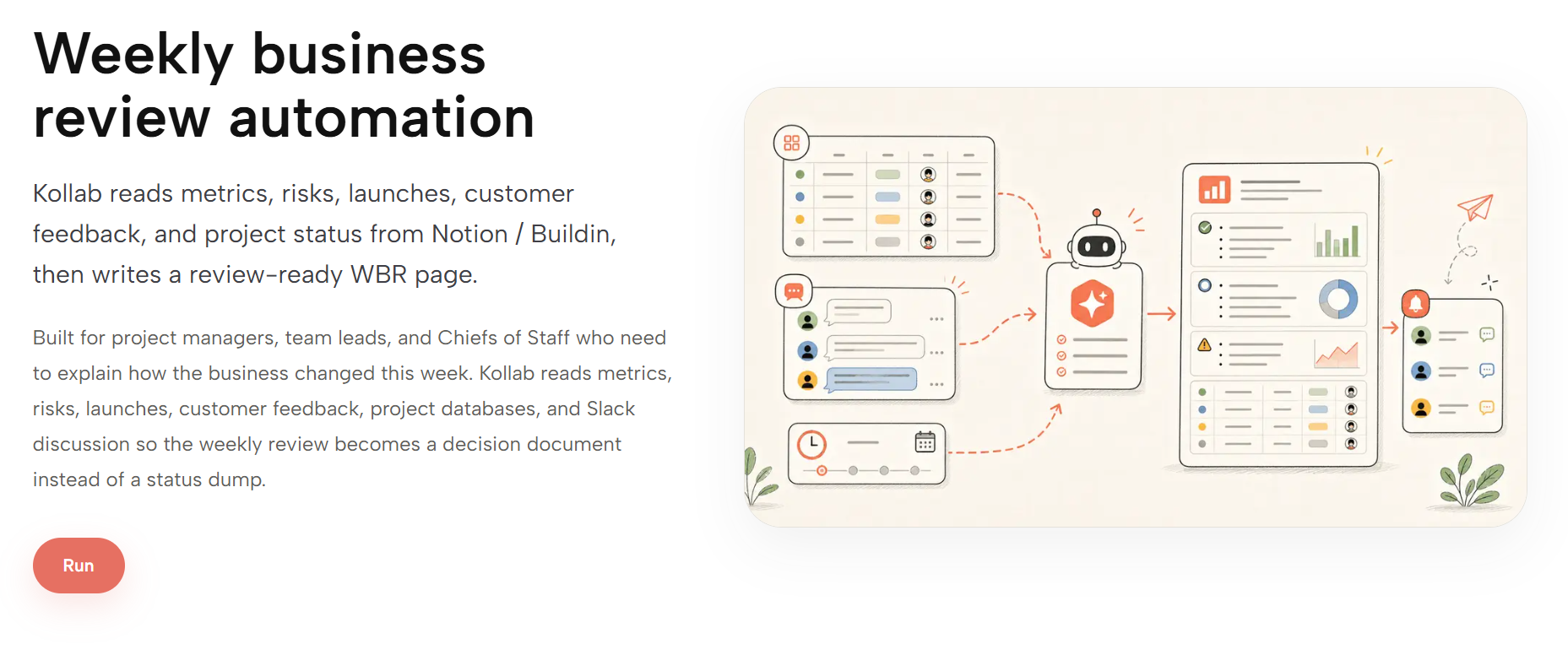
The problem: Writing the weekly business review means manually reading metrics, risks, launches, customer feedback, and Slack threads — then synthesizing it all into a document people will actually read.

How Kollab handles it: Kollab reads your metrics databases, project records, launch docs, customer feedback, and relevant Slack discussion. It synthesizes the week's changes, flags risks and open decisions, and produces a decision document instead of a status dump — ready for leadership review before the meeting starts.

Result: What used to take half a day now takes minutes. The review becomes a tool for making decisions, not just reporting what happened.

→ See the Weekly Business Review use case


3. OKR Alignment Assistant

Who it's for: Strategy leads, team managers, anyone running quarterly OKR cycles

From Content Pipelines to OKR Alignment: Real AI Workflows Teams Run Inside Kollab image

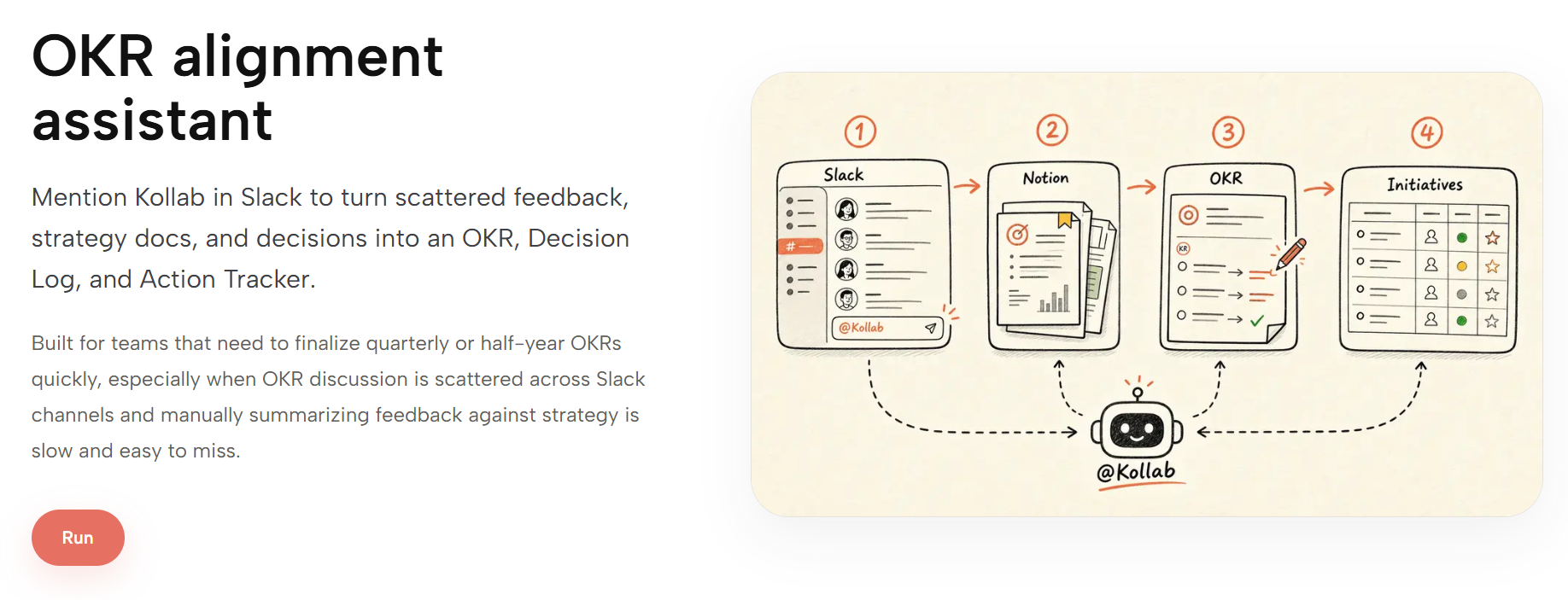
The problem: OKR discussion is scattered across Slack threads, strategy docs, and meeting notes. Synthesizing feedback and rewriting Key Results takes half a day — and it's easy to miss things.

How Kollab handles it: Mention@Kollab in the relevant Slack channel after an OKR discussion. The bot reads the thread, pulls your annual strategy document from Notion, rewrites the Key Results to be measurable and aligned, then generates an Initiative list, Decision Log, and Action Tracker — with owner, status, and priority — written back to your workspace.

Manual workflow With Kollab
Summarize feedback Read Slack channels manually Bot reads thread automatically
Align strategy Open Notion docs by hand Notion connector reads annual goals
Total time Half a day A few minutes

→ See the OKR Alignment use case


4. Turn Chat Bugs into GitHub Issues

Who it's for: Engineering teams, product managers, dev-facing support

From Content Pipelines to OKR Alignment: Real AI Workflows Teams Run Inside Kollab image

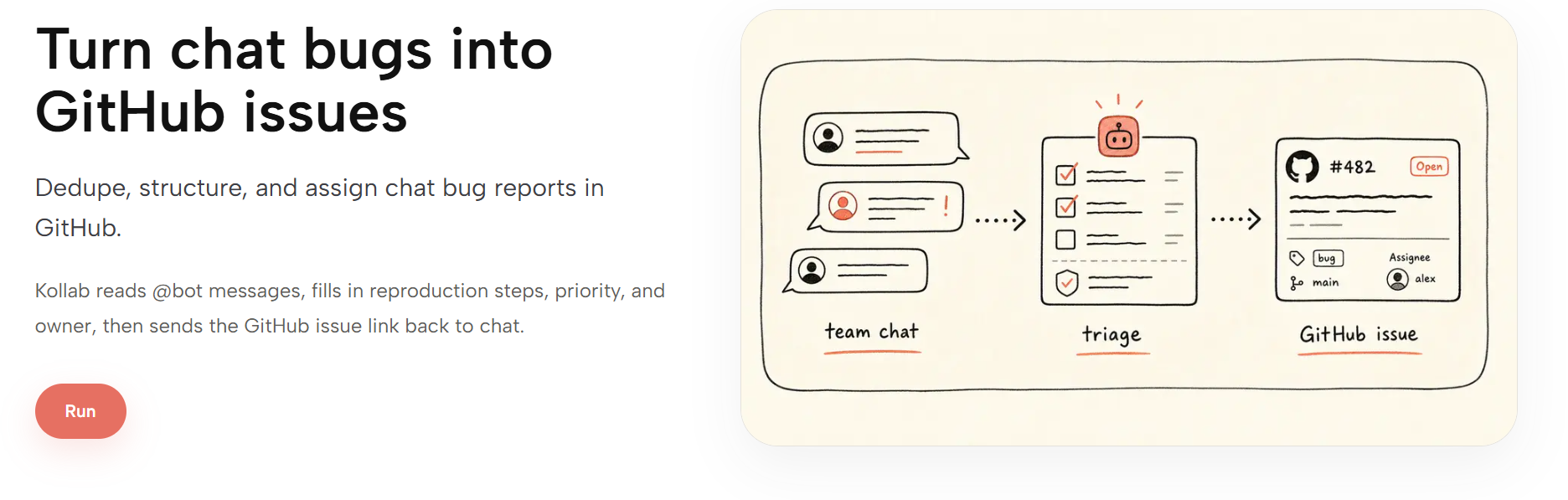
The problem: Bug reports arrive as informal chat messages. Someone has to convert them into structured GitHub issues — and it never happens fast enough.

How Kollab handles it: When a teammate sends a @bot message describing a bug, Kollab reads it, fills in reproduction steps, assigns a priority, suggests an owner, creates the GitHub issue, and sends the link back to chat. The whole team sees the result in the same thread.

Result: Zero drop-off between "someone noticed a bug" and "there's a structured GitHub issue."

→ See the Bug Reports to GitHub use case


5. AI Competitor Monitoring Workflow

Who it's for: GTM teams, product managers, founders, growth marketers

From Content Pipelines to OKR Alignment: Real AI Workflows Teams Run Inside Kollab image

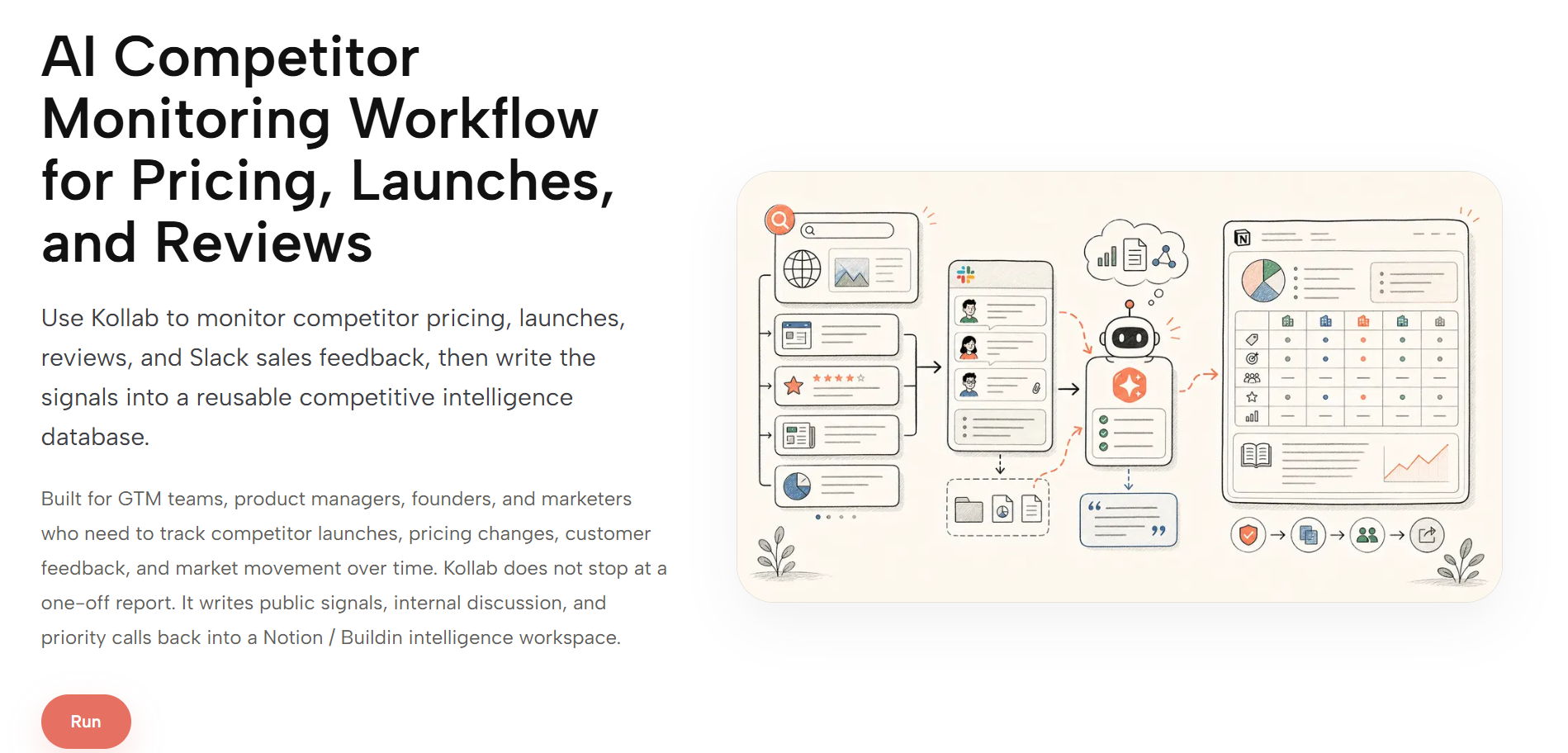
The problem: Keeping up with competitors means checking pricing pages, review sites, and news every week — manually. Most teams do it inconsistently or not at all.

How Kollab handles it: Kollab runs on a schedule and searches across your competitive landscape. Each signal gets categorized by type, source, what changed, why it matters, and suggested action — then written into a Competitive Intelligence database in Notion.

Output per run:

  • Competitors Database — positioning, pricing, product capability, watch status

  • Signals Database — structured records for every meaningful change

  • Weekly Intelligence Brief — prioritized summary with suggested next actions

→ See the CompetitorMonitoring use case


6. AI Meeting Notes with Action Items

Who it's for: Any team running recurring meetings, standups, or client calls

From Content Pipelines to OKR Alignment: Real AI Workflows Teams Run Inside Kollab image

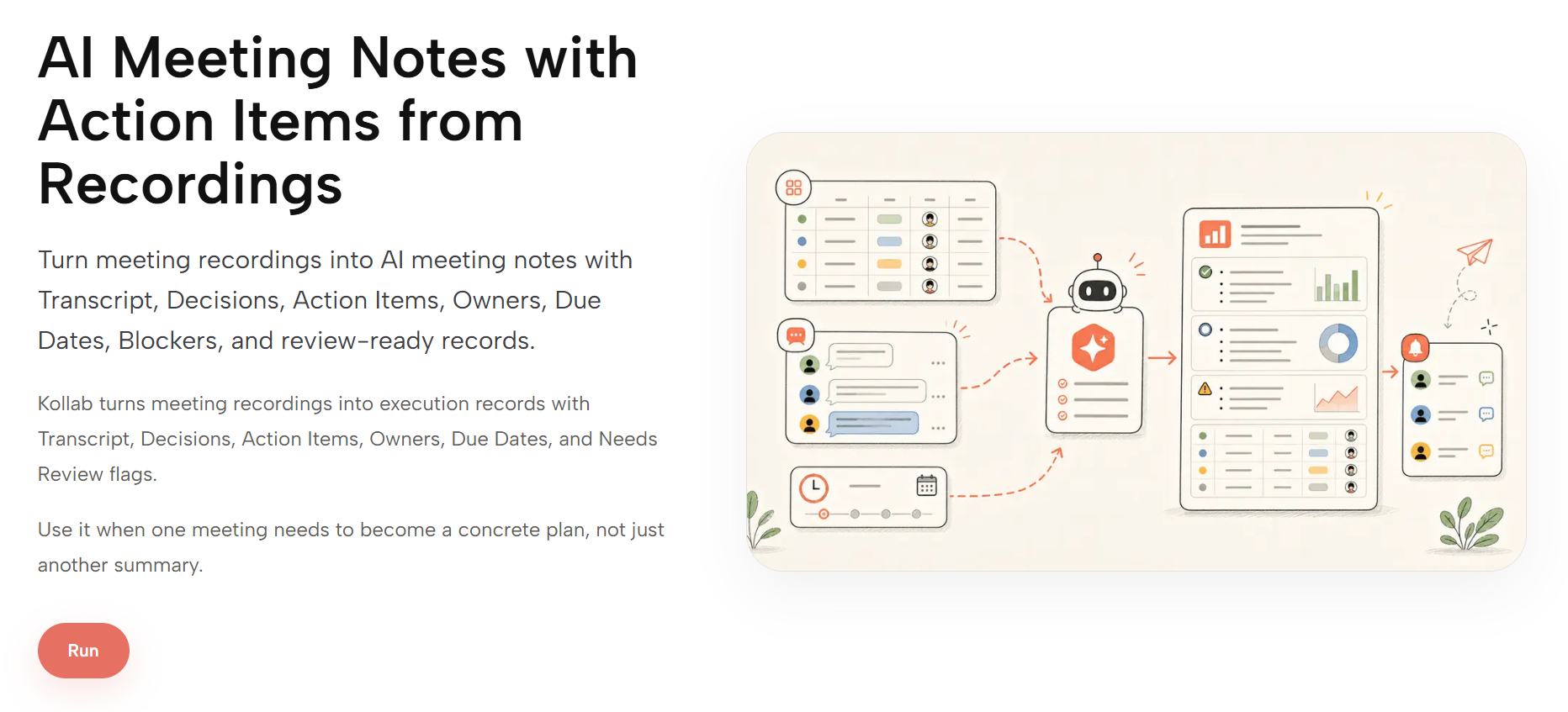
The problem: Meeting notes are either never written, inconsistently written, or missing real action items.

How Kollab handles it: Upload your meeting recording. Kollab produces a structured execution record: full transcript, key decisions, action items with owners, due dates, and a Needs Review flag for anything ambiguous.

Result: No more "who was supposed to do that?" moments. Every meeting leaves an audit trail.

→ See theMeeting Notes use case


7. KOL Content Campaign Workflow

Who it's for: Marketing teams, creator economy teams, brand partnerships

From Content Pipelines to OKR Alignment: Real AI Workflows Teams Run Inside Kollab image

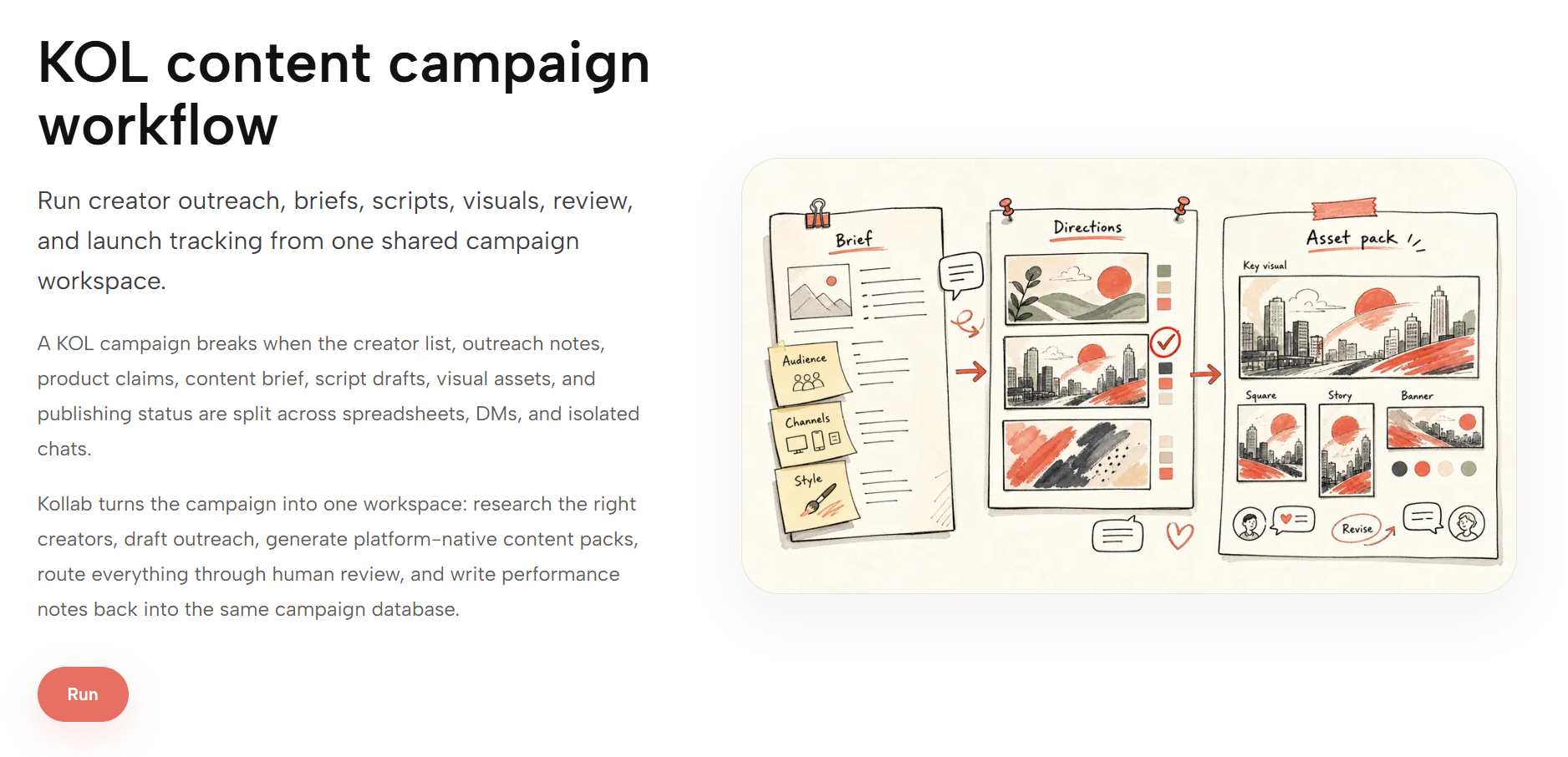
The problem: A KOL campaign falls apart when the creator list, briefs, scripts, assets, and publishing status live in spreadsheets, DMs, and isolated chats.

How Kollab handles it: Kollab turns your KOL campaign into an operating system — research the roster, draft individual briefs, generate aligned visual assets, track outreach status, and manage publishing — all in one connected workspace.

→ See the KOL Campaign use case


8. AI Presentation Workflow for Teams

Who it's for: Consultants, sales teams, product teams, anyone building decks

From Content Pipelines to OKR Alignment: Real AI Workflows Teams Run Inside Kollab image

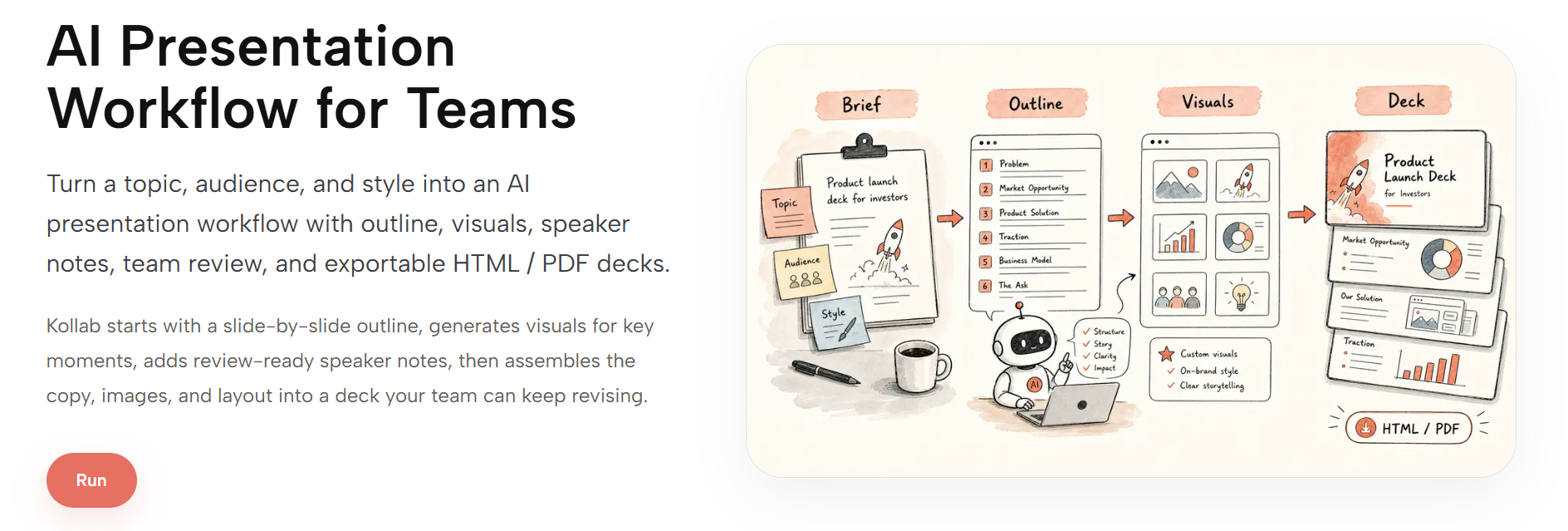
The problem: Building a presentation is slow because outline, visual sourcing, speaker notes, and assembly are four separate jobs that don't talk to each other.

How Kollab handles it: Kollab generates a slide-by-slide outline, creates visuals for key moments, writes speaker notes, and assembles everything into a deck your team can keep revising — all from one starting prompt.

→ See the Presentation Workflow use case


The Pattern Across All of These

Every use case above shares four traits:

  1. The work was already happening — Kollab makes existing processes reliable and fast, not invented from scratch.

  2. Human review stays in the loop — Kollab drafts, researches, and synthesizes. Humans approve.

  3. Outputs persist and compound — every run leaves a database, a document, a record. The next run builds on the last.

  4. Workflows are reusable — save any workflow as an Agent Skill, and your team runs it again next week with one click.

This is what separates Kollab from a chat AI: it's not about a better answer in a conversation window. It's about building a workspace where AI output accumulates into something your whole team can use.


Ready to run one of these workflows?

Explore all use cases at kollab.im/use-cases →

Start your workspace today: kollab.im

Follow Kollab: @Kollab_AI on X · @Kollab_AI on YouTube · LinkedIn

Keep exploring this topic

Use these next pages to move from the article into product details, comparisons, and workflow examples.