ICP
Segment records
- Buyer Role and Company Size
- Pain Point and Buying Trigger
- Best-fit and poor-fit patterns

Turn customer meetings into ICP segments, qualification signals, fit scores, and evidence-backed lead-scoring records.
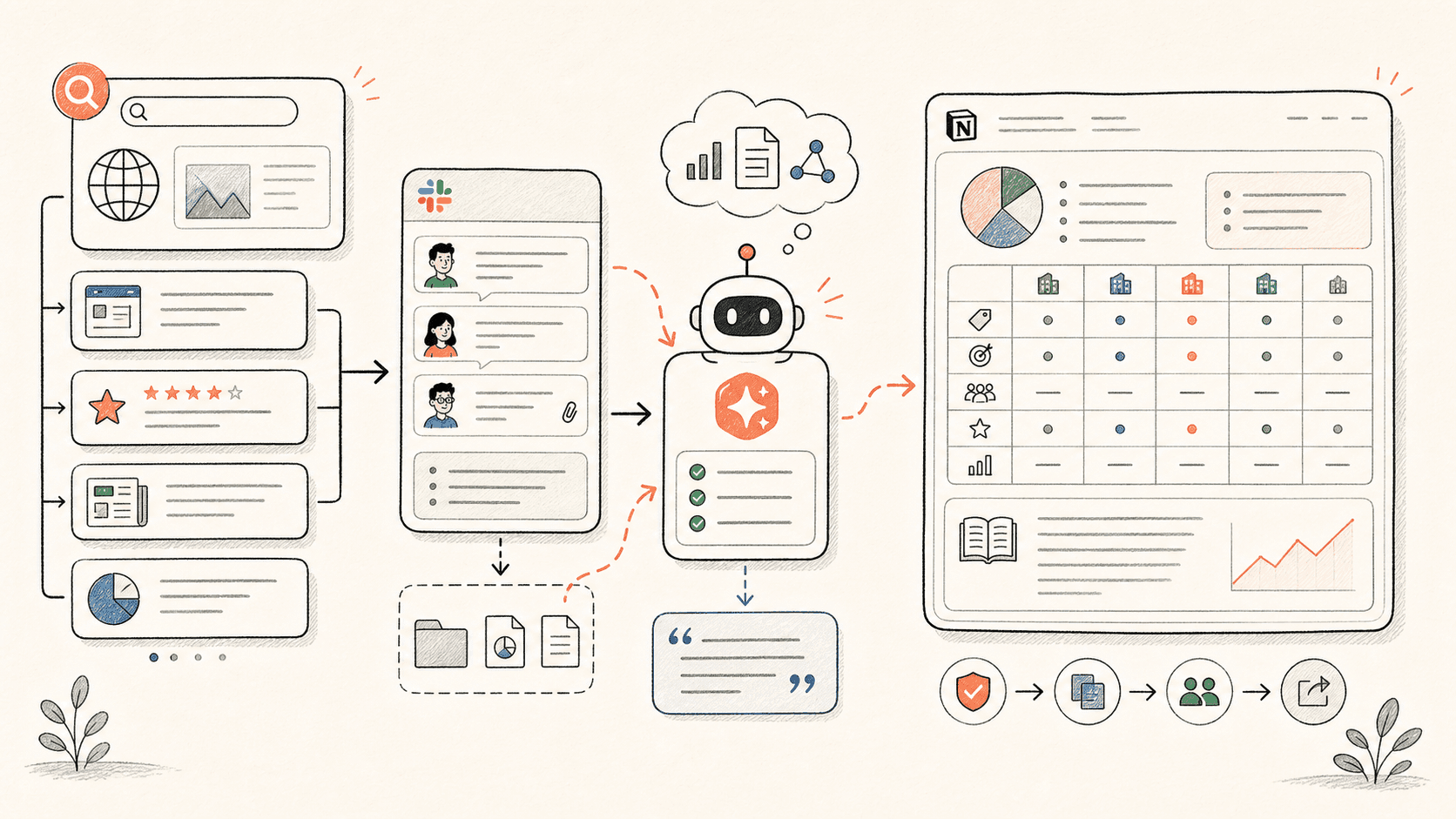
Kollab reads meeting audio, transcripts, and existing account context, then updates a structured ICP database with buyer roles, pain patterns, buying triggers, disqualification signals, and fit scores.
Use it when your team needs to learn which customers are a real fit across many conversations, not just follow up on one deal.
Read through the workflow once, then swap in your own roles, sources, and outputs.
Kollab reads recordings, transcripts, existing account records, and your current ICP hypothesis.
The agent pulls Buyer Role, Pain Point, Buying Trigger, Qualification Signal, Disqualification Signal, and Evidence Quote.
Existing accounts and segments are updated with Fit Score, Confidence, Review Status, and Data Enrichment Needed.
Kollab produces qualification questions, poor-fit filters, and the next experiment for sales or growth.
Build or update an ICP and lead-scoring database from these meeting notes.

Inputs:
- Meeting recordings or transcripts: [links or uploads]
- Existing account list: [database link or CSV]
- Product / offer: [what we sell]
- Target market hypothesis: [current ICP assumption]
- ICP database: [Notion / Buildin database link; if it does not exist, create "ICP and Lead Scoring"]

Read and update the Notion / Buildin database. If the database does not exist, create it with these fields:
- Account
- Segment
- Industry
- Company Size
- Buyer Role
- Pain Point
- Buying Trigger
- Qualification Signal
- Disqualification Signal
- Data Enrichment Needed
- Fit Score
- Next GTM Action
- Evidence Quote
- Source Meeting
- Confidence
- Review Status

Please:
1. Transcribe the meetings when audio is provided and link every record back to the Source Meeting.
2. Extract ICP signals from evidence only: buyer role, urgency, team size, budget cues, workflow pain, existing tools, buying trigger, and reason to disqualify.
3. Cluster accounts into segments and explain why each segment looks promising or weak.
4. Update existing ICP records instead of creating duplicates when the same segment or account already exists.
5. Create one Fit Score per account or segment, with Evidence Quotes and Confidence.
6. Mark weak evidence as Needs Review and list Data Enrichment Needed before changing the ICP.
7. End with a GTM summary: best-fit segment, poor-fit segment, sales qualification questions, and next experiment.
Kollab turns customer conversations into qualification logic your team can reuse.
| Manual ICP review | With Kollab | |
|---|---|---|
| Evidence | Meeting notes stay in separate docs and the ICP is updated from memory. | Every ICP change links back to Source Meeting, Transcript, and Evidence Quote. |
| Segmentation | Teams debate segments without consistent criteria. | Segments include Industry, Company Size, Buyer Role, Pain Point, and Fit Score. |
| Qualification | Sales questions drift from rep to rep. | Qualification Signals and Disqualification Signals become database fields. |
| Review | Weak assumptions become part of the ICP too early. | Low-confidence records stay in Needs Review with Data Enrichment Needed. |
| Total time | Loose notes and opinion-based ICP | Evidence-backed ICP and lead scoring |
The output should improve targeting, qualification, and sales learning.
ICP
Scoring
Evidence
Follow the related capability pages to see which product layers and tools make this use case repeatable for a team.
Turn customer meetings into ICP segments, qualification signals, fit scores, and evidence-backed lead-scoring records.
Copy the setup prompt into Kollab, replace the placeholders with your team context, then run it as a reviewable task in your workspace.
An ICP database with account segments, buyer roles, Pain Points, Buying Triggers, disqualification signals, Fit Scores, Evidence Quotes, Confidence, and Next GTM Actions.
No. The workflow is designed to produce reviewable drafts, briefs, artifacts, or database updates first, so your team can approve the result before anything is published or changed.
Keep segments, fit scores, qualification signals, and evidence in one database.
Run →