Critique
Prioritized page audit
- Top 5 clarity and conversion issues
- Section-level notes
- Unsupported or off-brand claims

Audit a landing page against your brand voice, product context, and launch goals, then turn the critique into a review-ready rewrite.
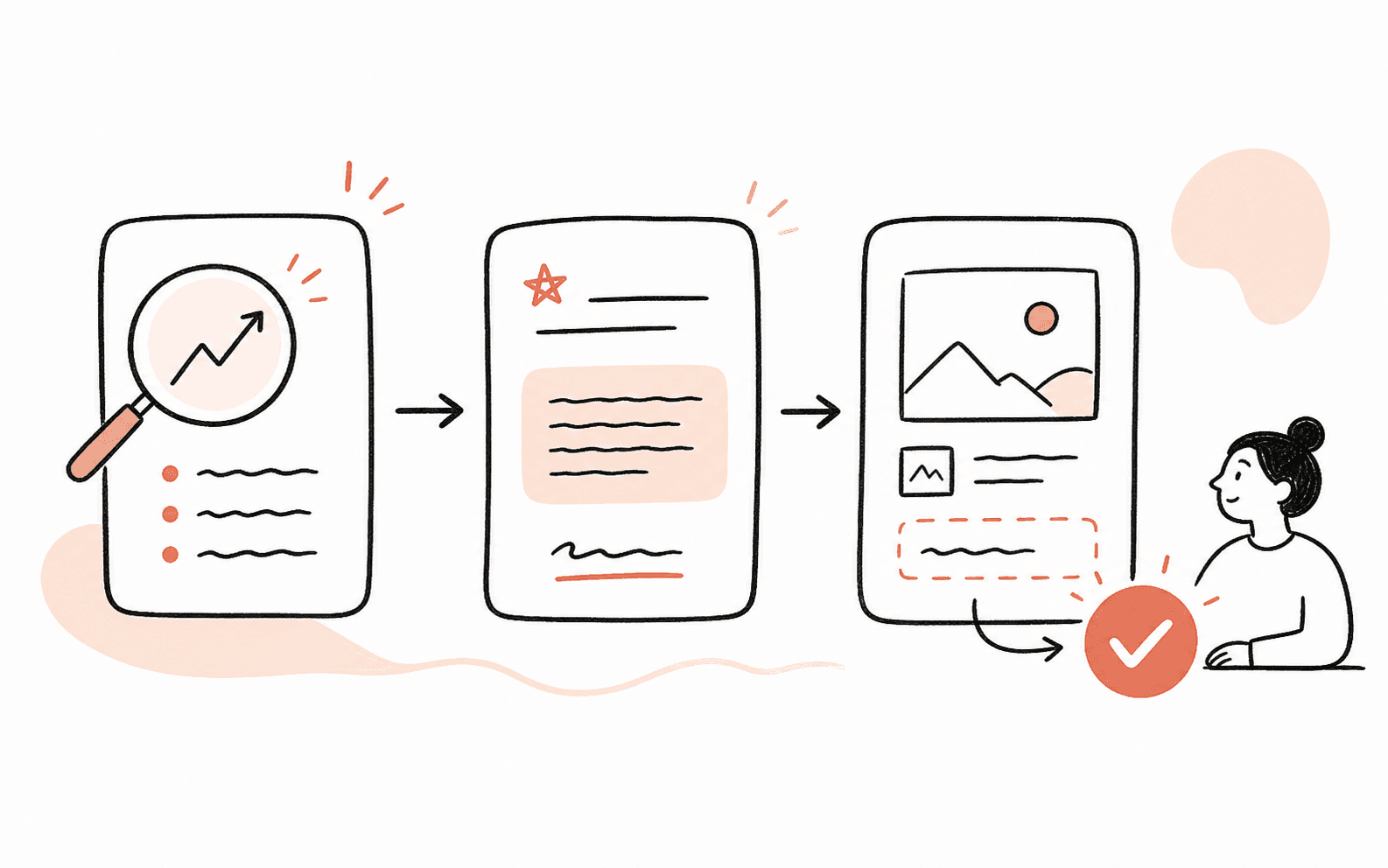
Landing page work usually gets stuck between scattered feedback, vague copy comments, and old positioning docs. Kollab can read the current page, screenshots, analytics notes, voice guides, launch briefs, and customer proof, then produce a structured critique and rewrite package.
This use case is deliberately narrower than a general content calendar. It is for teams that already know which page matters and need a faster way to align copy, layout notes, proof points, and implementation handoff before a human publishes.
Read through the workflow once, then swap in your own roles, sources, and outputs.
Kollab reviews the live page or screenshot alongside brand voice, launch goals, customer proof, and competitor references.
The agent explains what is unclear, unsupported, or off-brand before drafting new copy, so the team can review the reasoning.
The final output includes revised sections, proof sources, open questions, risk notes, and designer/developer implementation guidance.
I want to revise this landing page with Kollab.

Page to review:
- URL or screenshot: [landing page link or uploaded screenshot]
- Page goal: [signup, demo request, waitlist, template download, launch announcement]
- Primary audience: [who this page is for]
- Product or feature: [what we are selling or explaining]

Workspace context to use:
- Brand voice guide: [doc or knowledge base]
- Messaging goals: [positioning doc, launch brief, or campaign goal]
- Customer proof: [quotes, case studies, sales notes, support feedback]
- Competitors or alternatives to consider: [links or names]
- Constraints: [claims to avoid, legal limits, SEO keyword, design system notes]

Please run this workflow:
1. Audit the page section by section: hero, value proposition, proof, feature explanation, objections, CTA, FAQ, and mobile scanability.
2. Compare the current page with the brand voice guide, messaging goals, and customer proof. Call out claims that are vague, unsupported, or off-brand.
3. Identify the top 5 changes that would most improve clarity and conversion. Separate copy issues from layout or hierarchy issues.
4. Rewrite the page in a review-ready structure:
   - hero headline and subheadline
   - primary CTA and secondary CTA
   - section-by-section copy
   - proof points and where each proof point comes from
   - objection-handling blocks
   - FAQ items
5. Create an implementation brief for the designer or developer with changed sections, open questions, source evidence, and risk notes.
6. Do not invent customer proof or publish changes automatically. Mark anything that needs human approval.
Kollab keeps the review grounded in page goals, source evidence, and the team voice guide.
| Manual review | With Kollab | |
|---|---|---|
| Context | Reviewers comment from memory and miss the latest positioning or customer proof. | Kollab reads the page together with voice guide, launch brief, proof, and constraints. |
| Critique | Feedback stays vague: make it clearer, stronger, more premium. | Issues are tied to page sections, user questions, weak claims, and missing proof. |
| Rewrite | A rewrite becomes another disconnected doc that design and dev must interpret. | Revised copy, proof mapping, open questions, and implementation notes stay in one package. |
| Risk control | Unsupported claims and legal-sensitive wording are caught late. | Claims that need approval are marked before the page moves into production. |
| Total time | Feedback scattered across tools | Review-ready revision package |
The output is designed for human review and implementation, not autopublishing.
Critique
Rewrite
Handoff
Audit a landing page against your brand voice, product context, and launch goals, then turn the critique into a review-ready rewrite.
Copy the setup prompt into Kollab, replace the placeholders with your team context, then run it as a reviewable task in your workspace.
A landing page revision brief with prioritized critique, rewritten hero and sections, proof mapping, objection blocks, FAQ items, and implementation notes.
No. The workflow is designed to produce reviewable drafts, briefs, artifacts, or database updates first, so your team can approve the result before anything is published or changed.
Use Kollab to audit the page, ground the copy in your workspace, and leave a clean handoff for review.
Run →