AI Pitch Deck Creator vs Pitch Deck Template: Which Should Founders Use?
Compare AI pitch deck creators with traditional pitch deck templates, including when to use each, how to combine them, and how founders can build better fundraising decks.
Introduction
Founders today have more ways than ever to build their fundraising narrative. You can download a classic pitch deck template from a top-tier VC, copy the slide order from a famous unicorn startup, use a dedicated AI pitch deck creator, or ask a general AI chat tool to draft your story.
But here is the hard truth: the hardest part of fundraising is not choosing the flashiest design tool. The hardest part is choosing the right starting point for your current stage of thinking and business maturity.
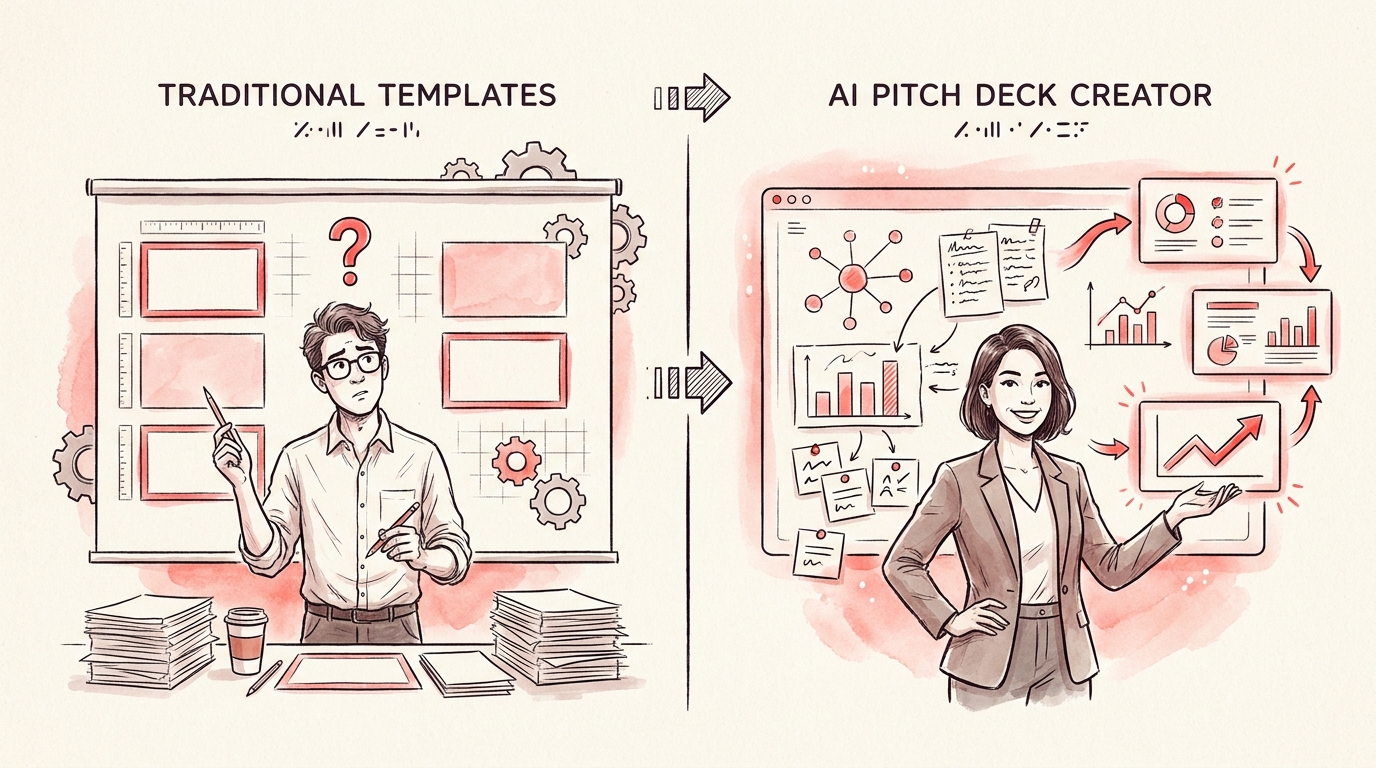
A pitch deck template gives you reliable structure. An AI pitch deck creator gives you dynamic adaptation and narrative generation. The most successful founders usually need both: the disciplined framework of a standard investor deck and a smart workflow that can synthesize their specific business context into a credible, compelling narrative.
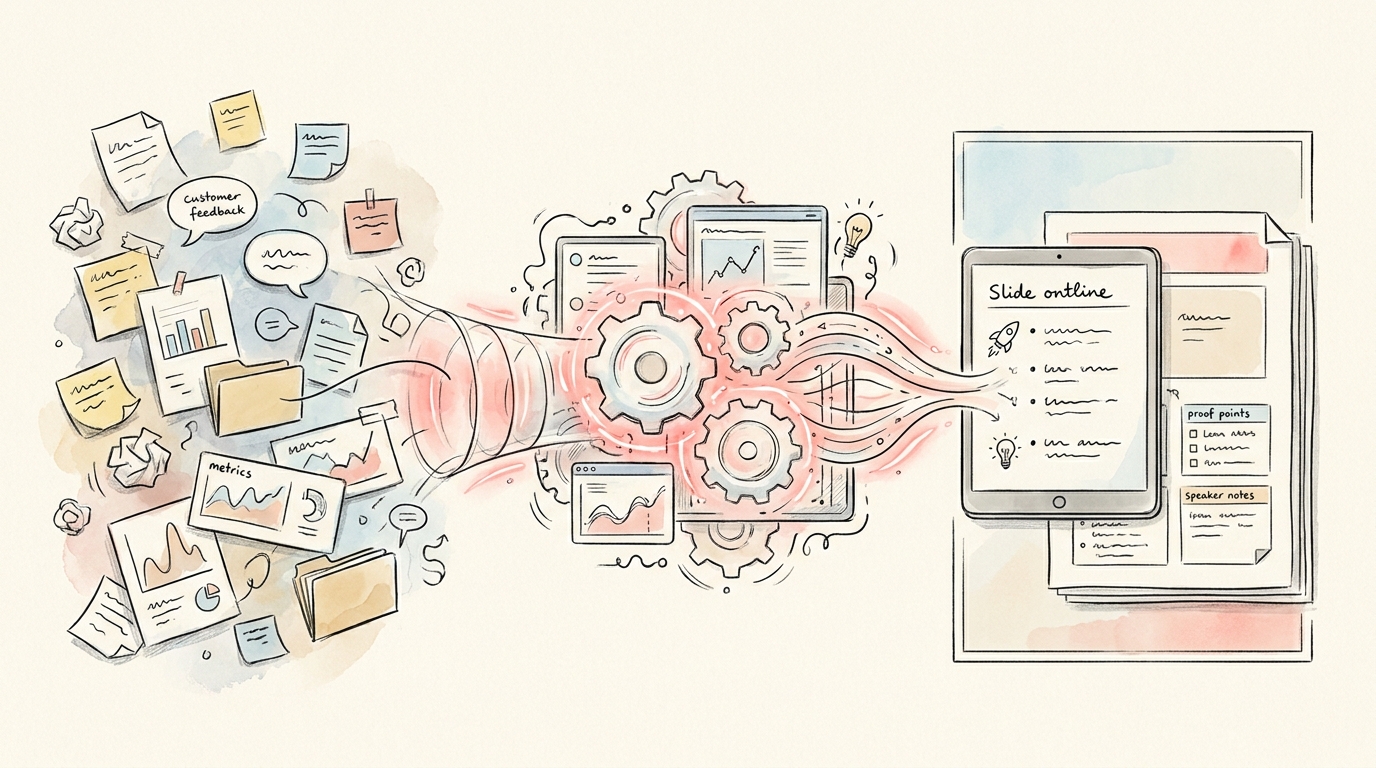
If you already have a rough startup idea and want a customized first draft, Kollab's AI pitch deck creator can generate a comprehensive slide outline, strategic proof points, detailed speaker notes, and review context from just a single brief. In this comprehensive guide, we compare that modern AI-driven workflow with traditional pitch deck templates so you can choose the right path for your next raise.
The Short Answer: Which Should You Choose?
Use a pitch deck template when you need quick structural formatting and already know exactly what each slide should say.
Use an AI pitch deck creator when you have raw notes, unclear positioning, multiple possible narrative angles, or need to quickly adapt the deck for different audiences (e.g., angels vs. institutional VCs).
Use both when you want the rigorous discipline of a standard investor deck combined with the speed and strategic edge of AI-assisted drafting.
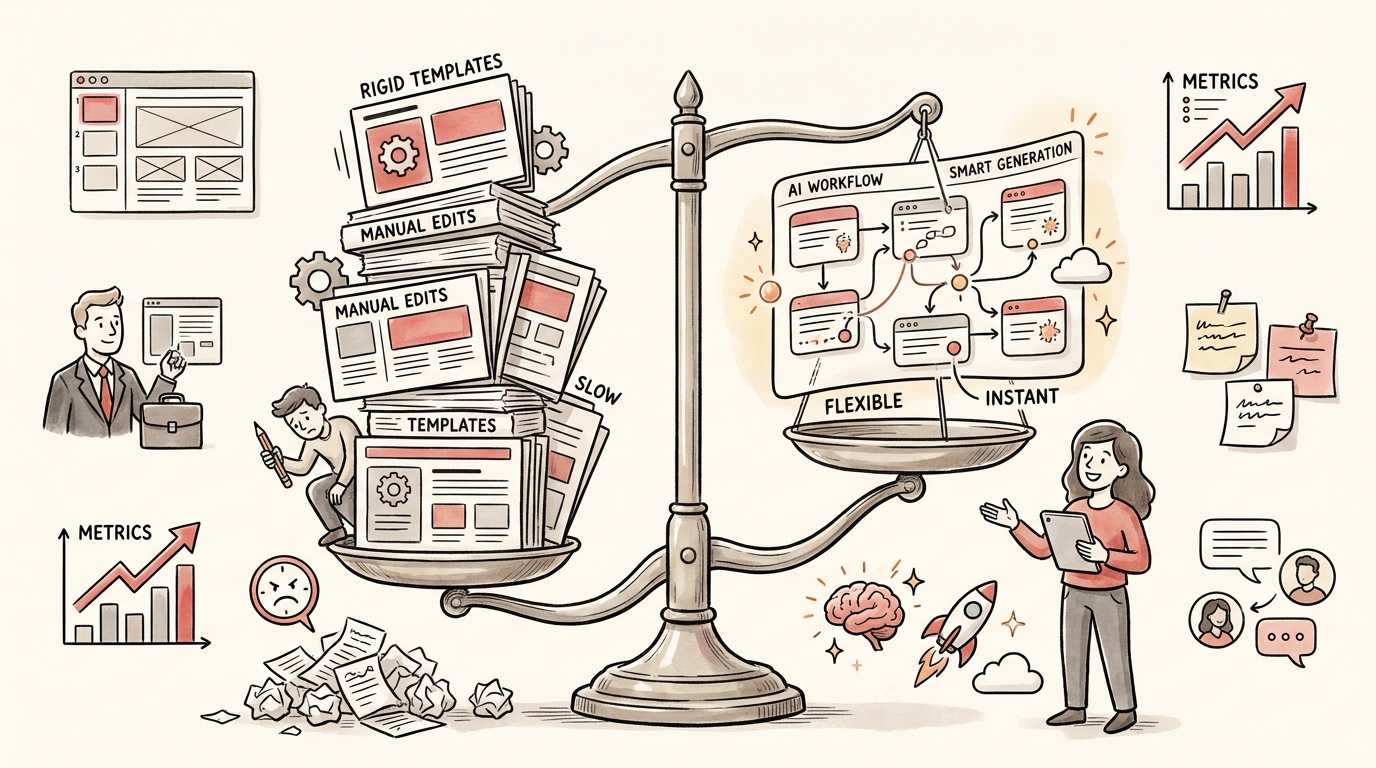
Pitch Deck Template vs AI Pitch Deck Creator Comparison
To understand which tool fits your current fundraising stage, let's look at a direct comparison:
| Feature | Pitch Deck Template | AI Pitch Deck Creator |
|---|---|---|
| Best for... | Structure, layout, and visual consistency | Narrative shaping, brainstorming, and adaptation |
| Starting input | Manual slide-by-slide writing and formatting | Startup brief, raw notes, metrics, files, comments |
| Typical Output | Static slide format with placeholder text | Draft outline, slide copy, proof points, speaker notes |
| Core Strength | Prevents you from missing standard required slides | Turns messy context and brain dumps into a specific story |
| Main Weakness | Can become generic and fail to highlight your unique edge | Can overstate claims or hallucinate if not properly reviewed |
| Ideal User | A founder who already has a locked-in core message | A founder still shaping and refining their startup message |
Ultimately, the choice is not really about template versus AI. It is about choosing a static structure versus an adaptive workflow.
The Role of Traditional Pitch Deck Templates
What Pitch Deck Templates Do Well
Pitch deck templates are incredibly popular for a good reason. They help founders avoid the dreaded blank page syndrome and enforce the standard investor deck sequence that VCs expect to see.
A high-quality template provides immense value by offering:
Proven Slide Order: Ensuring you flow logically from Problem to Solution, Market, Traction, and Team.
Visual Hierarchy: Guiding the viewer's eye to the most important metrics or statements.
Familiarity: Meeting common investor expectations, reducing cognitive load for VCs reviewing hundreds of decks.
Design Speed: Faster formatting so you don't waste hours aligning text boxes.
Templates are especially useful when you already have strong, refined raw material. If you know exactly what your problem, market, traction, business model, and ask are, a template helps you package that story quickly and professionally.
Where Templates Break Down
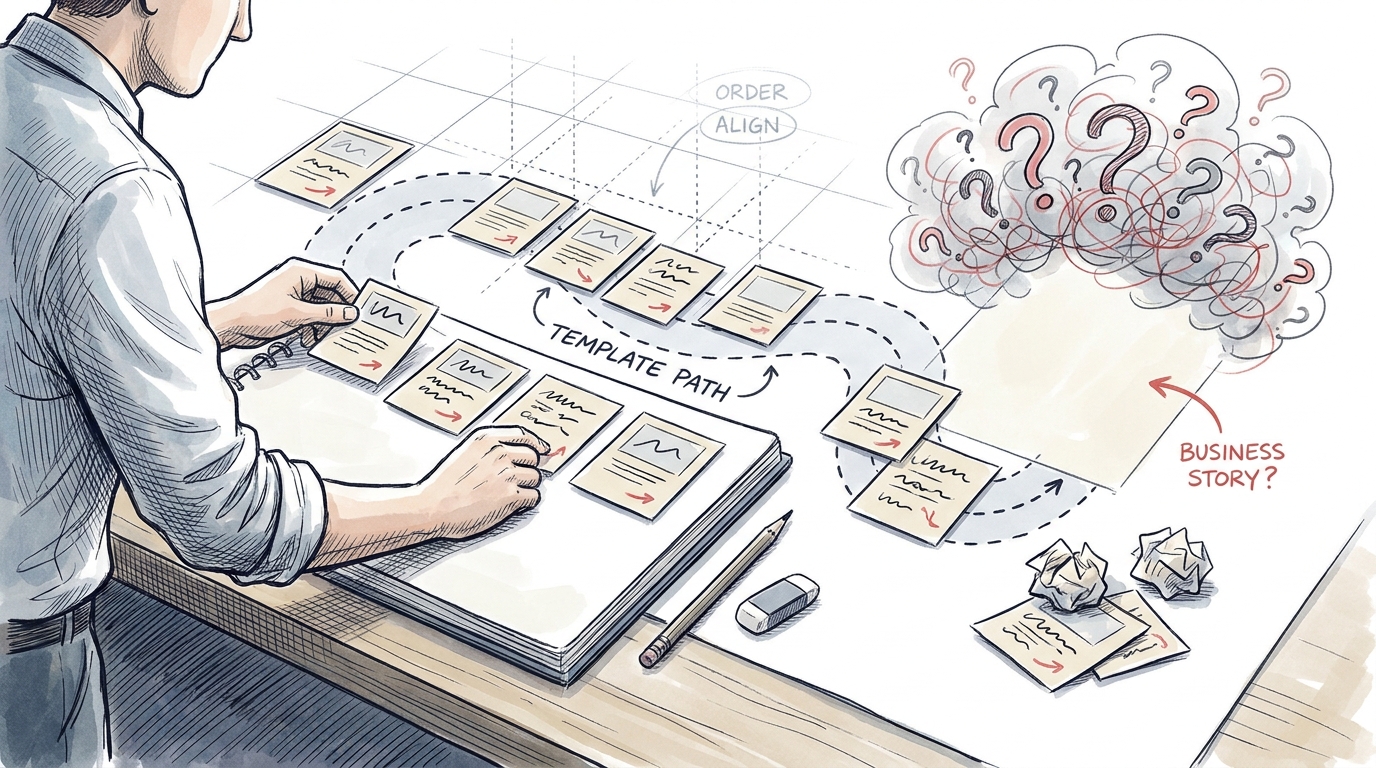
However, templates become significantly less useful when the core startup story is still unresolved or evolving.
Common pitfalls of relying solely on a template include:
Weak Narrative Flow: The slide order looks technically correct, but the overarching narrative lacks a compelling hook.
Generic Copy: The messaging sounds bland because it was slightly tweaked from generic placeholder text.
Information Overload: Founders feel compelled to fill every empty box on a slide without knowing which claim actually matters most to investors.
Superficial Analysis: Market and competition slides become copied visual patterns (like the classic 2x2 matrix) instead of representing real, rigorous strategic analysis.
A template can tell you that you need a traction slide. It cannot help you decide which traction story is the absolute strongest for your current seed stage.
The Rise of the AI Pitch Deck Creator
What an AI Pitch Deck Creator Does Differently
Unlike a static file, an AI pitch deck creator starts from your unique business context instead of a hollow slide shell.
A powerful AI fundraising workflow can transform your preparation by:
Extracting the Core Story: Reading a messy, unstructured founder brief and pulling out the most compelling angle.
Suggesting Narrative Angles: Proposing multiple ways to pitch (e.g., product-led growth focus vs. massive market timing focus).
Drafting Comprehensive Content: Writing slide titles, key messages, and punchy bullet points.
Building Proof-Point Checklists: Identifying exactly what data or metrics you need to prove each slide's claim.
Generating Speaker Notes: Giving you the exact talking track to accompany the visual slide.
Audience Adaptation: Instantly tailoring the deck's tone and detail level for angel investors, specialized seed funds, enterprise customers, or board updates.
This is why founders are increasingly searching for terms like AI pitch deck generator, pitch deck builder, and pitch deck maker. They aren't just looking for a prettier file—they are looking for an intelligent sounding board to turn uncertainty into a bulletproof investor story.
When to Use Which Approach First
When to Start with a Template
Start your process with a traditional pitch deck template when:
You already have a crystal-clear, pressure-tested narrative.
Your co-founders and advisors completely agree on your market positioning.
Your key metrics, financial models, and growth data are perfectly organized.
You mainly need help with slide layout, typography, and visual polish.
You are creating a brief, standard monthly update deck, not a foundational fundraising story.
In these cases, AI can still be used to refine or punch up individual sentences, but the template will serve as your primary skeleton.
When to Start with AI
Start your process with an AI pitch deck creator when:
Your startup story is still messy, complex, or difficult to explain simply.
You have scattered notes, strategy docs, or raw metrics but lack a cohesive structure.
You are unsure whether you should lead your pitch with the problem, your early traction, market timing, or your disruptive technology.
You anticipate needing different versions of the pitch for different types of audiences.
You want to practice with AI-generated speaker notes and anticipate tough investor objections.
For this dynamic workflow, using a tool like Kollab's pitch deck builder to generate your initial strategic structure is a game-changer.
The Best Workflow: AI First, Template Second
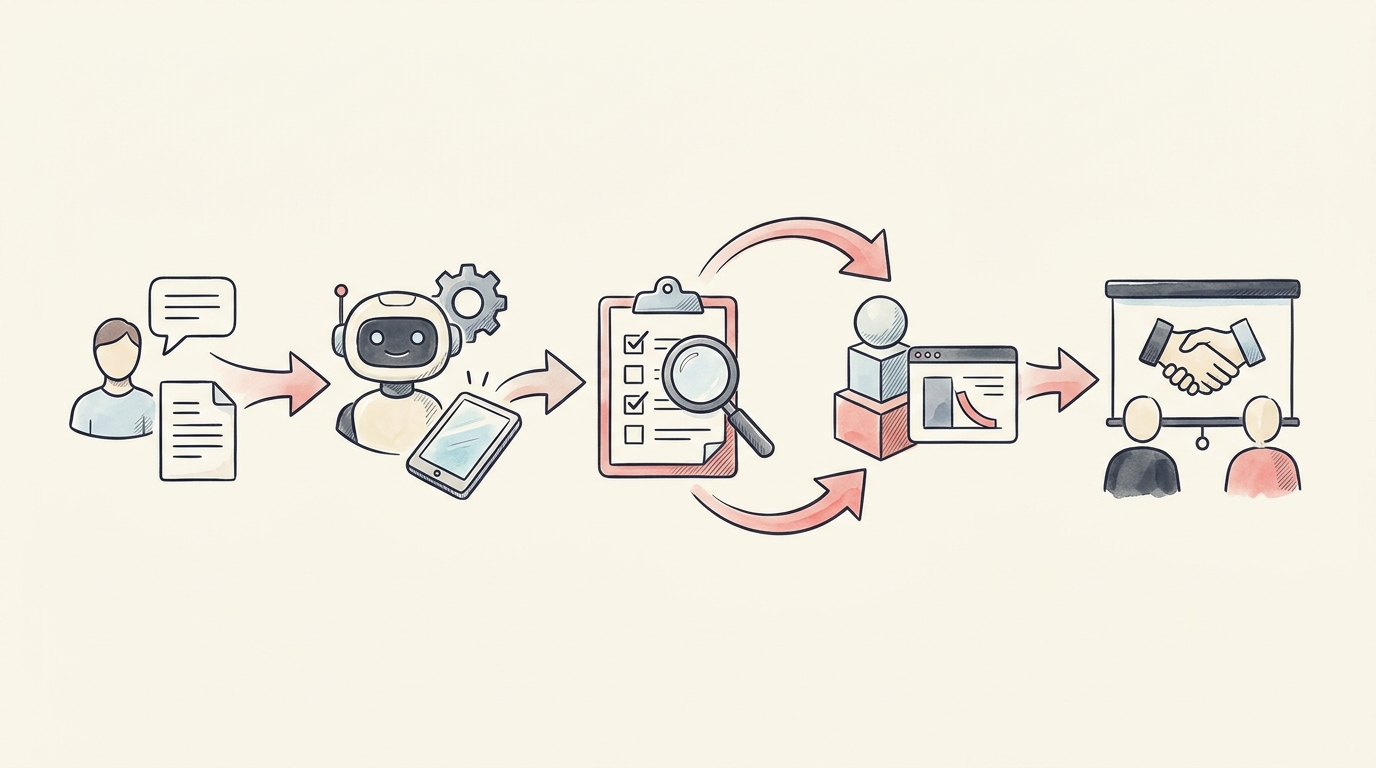
The most practical, time-efficient approach for modern founders is a hybrid workflow:
Clarify the Story with AI: Dump your raw thoughts, customer feedback, and metrics into the AI to brainstorm narrative angles.
Draft the Slide Outline: Use the AI to generate a complete slide-by-slide outline, including titles, main takeaways, and necessary visual concepts.
Review and Verify: Critically review the AI output. Check all facts, pressure-test assumptions, and identify data gaps.
Apply the Template: Once the story is locked in, choose a high-quality visual template. This is where template discipline shines.
Convert Outline to Slides: Port your AI-refined copy into the template's visual constraints (if you are building the final deck in PPT, check out our complete guide to PowerPoint and AI automation to speed up this step).
Iterate with Team Feedback: Use your team's feedback to revise the deck collaboratively.
Generate Variations: Use AI to quickly spin up variations of the finalized deck for specific investor meetings.
This order matters immensely. If you start with a beautiful template before your story is clear, you will inevitably waste hours polishing the wrong argument.
Real-World Example: Template-Only vs AI-Assisted Output
Imagine a founder building an AI-powered note-taking product specifically for field sales teams.
The Template-Only Output:
A standard template might prompt the founder to produce this generic slide list:
Problem: Sales takes too much time.
Solution: AI notes for sales.
Market: $10B CRM market.
Product: Mobile app screenshot.
Business Model: $20/user/month.
Team: 2 ex-Google engineers.
Ask: $2M Seed.
Result: It's reasonable, but it's entirely forgettable. It sounds like every other SaaS pitch.
The AI-Assisted Output:
An AI-assisted workflow forces specificity and creates a sharper narrative:
Problem: Field reps lose critical deal context between in-person meetings and their desks, spending 10+ hours a week manually updating CRMs.
Why Now (Timing): Sales organizations are under immense pressure to drive productivity and revenue without adding new headcount.
Solution: Instant AI meeting capture that automatically syncs structured data to Salesforce and drafts follow-up emails while the rep is still in the parking lot.
Traction: 12 active enterprise pilot teams, 4 fully paid annual contracts, and validated data showing 5 hours saved per rep per week.
GTM Wedge: Start obsessively with field sales notes, establish habit-forming daily active use, then expand horizontally into broader sales workflow automation.
Ask: Raising $2M to scale customer acquisition to 50 enterprise logos and deepen proprietary CRM integrations.
The difference is night and day. The AI didn't just provide wording; it helped formulate the actual business argument.
Do Investors Care if You Use an AI Pitch Deck Generator?
A common anxiety among founders is whether investors will judge them for using an AI pitch deck maker. The reality is that investors care about clarity, credibility, and traction—not the tools you used to format your slides.
If an AI tool helps you articulate your value proposition more clearly and succinctly, investors will appreciate the respect for their time. However, if your deck feels hollow, uses excessive buzzwords ("revolutionary paradigm shift"), or contains hallucinated market sizing, investors will immediately pass. AI is a co-pilot, not a replacement for founder vision and honesty.
Risks of Using AI for Pitch Decks
While powerful, AI can sometimes make weak or unvalidated ideas sound polished and finished. That is useful for brainstorming but incredibly risky for actual fundraising.
When using an AI pitch deck creator, always watch out for:
Invented Metrics: Never let AI guess your traction or unit economics.
Overconfident Market Sizing: AI defaults to massive TAMs (Total Addressable Markets); ensure you can mathematically defend the numbers.
Unsupported Competitor Claims: Ensure your competitive matrix is factually accurate.
Generic Buzzwords: Edit out adjectives and replace them with hard evidence.
Confidentiality: Be mindful of pasting highly sensitive IP or proprietary algorithms into public AI models. (Kollab workspaces provide secure environments for this).
A responsible founder workflow asks the AI to identify weak assumptions and stress-test the pitch, rather than asking the AI to hide flaws behind pretty words.
Why Kollab is the Ultimate Pitch Deck Builder
A generic AI chatbot can help you draft a basic deck, but building an investor-ready pitch quickly becomes a deeply collaborative process. You need to juggle financial files, user metrics, advisor comments, countless revisions, and decision history.
Kollab elevates the process by keeping your entire deck workflow in a unified, shared workspace:
Context is King: The initial prompt and business brief become a central task.
Connected Outlines: The generated outline stays permanently linked to your raw context and research.
Seamless Collaboration: Teammates, co-founders, and advisors can add files and inline feedback directly.
Contextual Revisions: The AI can intelligently revise specific slides based on ongoing comment threads without losing the broader narrative.
This makes Kollab not just another AI pitch deck generator, but a comprehensive operational workflow for evolving your deck from a rough idea to a funded reality.
Frequently Asked Questions (FAQ)
Is an AI pitch deck creator better than a template?
Not inherently. AI excels at shaping the underlying story and adapting your messaging to specific contexts. Templates excel at visual consistency and layout speed. The smartest founders use AI first for the narrative, and a template second for the design.
Can AI design and create a complete pitch deck presentation?
AI can brilliantly draft the structural outline, slide copy, speaker notes, and suggest visual directions. However, formatting those words into a stunning, pixel-perfect presentation still benefits heavily from a great template or a human designer.
What should I include in my prompt for an AI pitch deck maker?
To get the best results, provide raw details about your: product, target customer, core problem, market size, current traction, business model, main competitors, team background, funding stage, desired raise amount, and the specific investor audience you are targeting.
Will AI guarantee me funding?
No tool can guarantee funding. Investors fund exceptional teams, strong traction, and massive market opportunities. AI simply ensures that your presentation clearly communicates those strengths without getting in your own way.
Final Takeaway
A pitch deck template helps you avoid the paralysis of a blank page. An AI pitch deck creator helps you avoid the fatal mistake of a generic, unconvincing story. When it comes to raising capital, solving the narrative problem is infinitely more important than solving the formatting problem.
Start with Kollab's AI pitch deck creator when you need to forge a customized, bulletproof investor narrative. Then, apply your preferred visual template once your story is undeniable.
Further Reading: